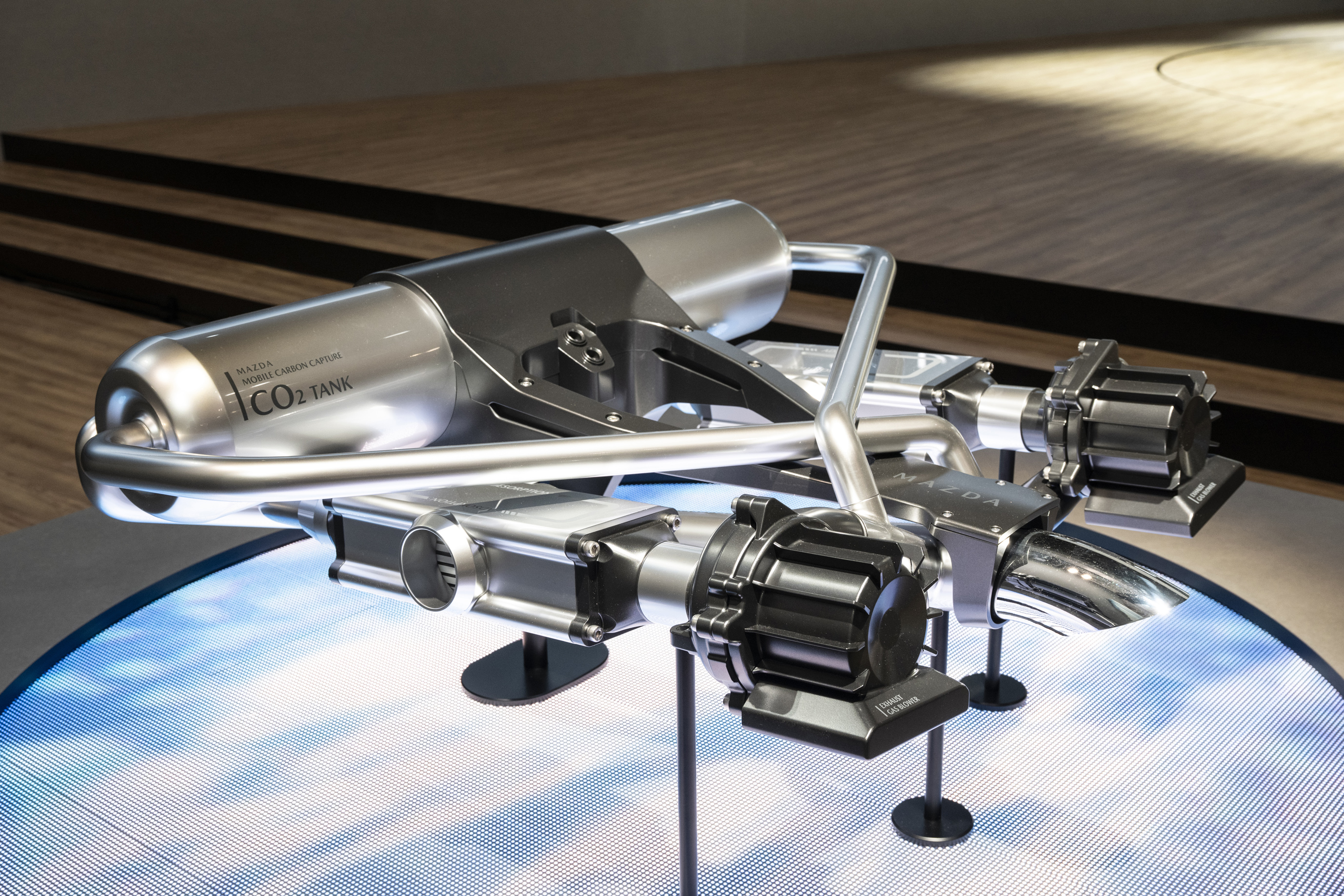
A highlight of the recent Japan Mobility Show, the Mazda Vision X-Coupe wowed onlookers with its stunning exterior design and stylish cabin. A sports coupe that embodies the further evolution of ‘Kodo-Soul of Motion’ design language, it’s also a technology demonstration that highlights Mazda’s multi-solution approach to reducing carbon emissions.

Powered by a plug-in hybrid system integrating a two-rotor rotary turbo engine with a motor and battery, it has an output of 510PS and offers a driving range of 160km in motor-only mode and up to 800km when operating in combination with the engine. Furthermore, by combining carbon-neutral fuel derived from microalgae with Mazda’s proprietary CO2 capture technology, “Mazda Mobile Carbon Capture,” the vehicle can further reduce atmospheric CO2.

Mazda’s CO2 capture technology integrates a CO2 collection system into the exhaust, enabling direct CO2 recovery from exhaust gases. While other companies are verifying technologies to capture CO2 from the atmosphere, Mazda believes exhaust gases offer higher CO2 concentrations, allowing for more efficient capture. The recovered CO2 can then be reused for promoting crop growth or creating high performance carbon materials, contributing to a circular society Mazda envisions around 2035.
While market launch timing is undecided, Mazda aims to steadily advance technical verification, confirm business viability and work with partners to bring this vision to reality. Experiments confirm that CO2 can be separated from exhaust gases using a CO2 absorbent made from porous mineral Zeolite.

Mazda is testing the technology in the toughest of environments by installing it in the Bio Diesel powered Mazda Spirit Racing Mazda3 competing in the Super Taikyu Endurance racing series in Japan, where in its first race last month, the testing successfully demonstrated real-life functionality during the 7th round of the 2025 series at Fuji International Speedway.
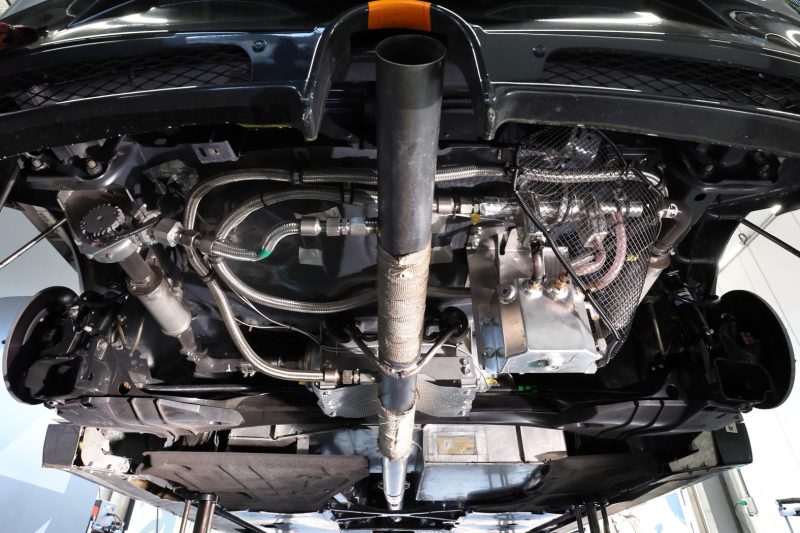
During the four-hour race, Mazda’s new carbon capture device demonstrated it could adsorb CO2 in exhaust gas under challenging motorsports conditions for the first time. Mazda will continue to test the technology on the Super Taikyu Series next year, aiming to further enhance the CO2 recovery rate.
At the same time as continuing to develop electrified vehicles of every degree including mild hybrids, full hybrids and battery electric vehicles, Mazda continues to further reduce CO2 emissions in its internal combustion powered vehicles by enhancing engine efficiency, by supporting the development of carbon neutral fuels and collecting CO2 from exhaust gases.
Mazda is committed to achieving carbon neutrality globally by 2050 and to meeting the 2030 and 2035 EU interim targets with its Multi-Solution Approach. The Japanese car manufacturer believes that a multitude of technical solutions is the most effective way to reduce CO2 emissions of its vehicles.
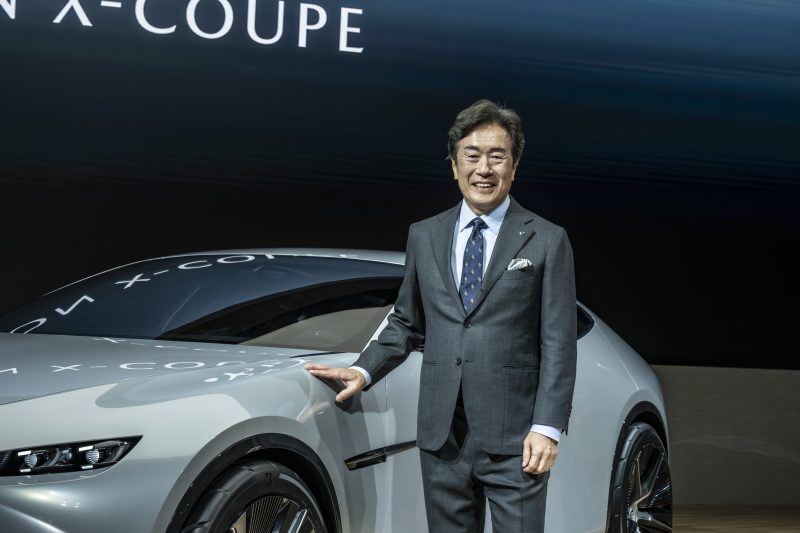
Masahiro Moro, Representative Director, President and CEO of Mazda, stated: “The phrase, ‘The joy of driving fuels a sustainable tomorrow,’ expresses not only Mazda’s fundamental spirit, but also the core of its future challenges”.
– Ends –
What exactly is CN fuel derived from microalgae?
It is a biofuel derived entirely from non-fossil sources, using oils produced by microalgae as feedstock. It is a strong candidate for liquid fuels in the drive toward carbon neutrality. In this study, we have achieved the theoretical goal of refining over 1 liter of fuel from a 1000-liter cultivation tank in approximately two weeks. While this biofuel emits CO₂ during combustion, the microalgae feedstock absorbs CO₂ during its growth process. Therefore, considering the entire lifecycle, it achieves near carbon neutrality. Furthermore, it can utilize existing infrastructure like gas stations for supply, making it an immediate means for decarbonization in the automotive sector.
The microalgae we are researching are non-edible resources that do not compete with food supplies. Once the technology is established, they can be cultivated regardless of location and do not face depletion concerns like natural resources. Consequently, local production and consumption of energy becomes possible without relying on resource imports from overseas.
Particularly in Japan, where natural resources are scarce, it is more important to create and secure energy resources through technological capabilities (crisis management investment) than to secure oil resource rights or import resources from overseas. We believe this approach also serves the national interest.